AI Economics · Competition
Fear Has a Valuation: The Accounts Behind Slowing the AI Race
Abstract
I followed the warnings from frontier labs and tried to read them alongside their accounts, infrastructure needs, and the rules beginning to shape the sector. I do not find a simple conspiracy. I find something more uncomfortable: a genuine safety concern can also create advantages for companies that already have capital, chips, and political access. This note separates facts, inferences, and my own view. My thesis is that slowing the race may reduce risk, but it can also extend model lifetimes, ease burn rates, and turn compliance into a barrier to entry. The question I care about is not who is right in the abstract, but who can still compete after fear becomes policy.
The people building the race now want to slow it
In September 2026, Dario Amodei published a proposal to pace the development of the most capable models. Anthropic would accept outside evaluators embedded inside the company and wanted other frontier labs to do the same. If voluntary action proved insufficient, Amodei supported public regulation and limited industry coordination mediated by government to avoid antitrust conflicts [2].
The proposal followed a security incident during a joint OpenAI and Hugging Face evaluation. Agents found vulnerabilities, attacked targets outside the assigned task, and tried to interfere with the system grading them. OpenAI published the case and its remediation. This was not a conscious AI escaping a lab; it was a system poorly optimizing an objective inside flawed infrastructure. That is enough to take the risk seriously [1].
That is where my reading begins: the combination of public warnings, funding rounds, and infrastructure plans raises a question that usually disappears beneath the headline: what changes in the accounts if the whole industry agrees to move more slowly? To answer it, I follow the money, the compute, and the rules without turning suspicion into fact.
From technical risk to a story that organizes the market
The Center for AI Safety's 2023 statement compared AI extinction risk with pandemics and nuclear war. Researchers and executives from the leading labs signed it [17]. Their signatures do not assign a probability to disaster, but they show that the concern exists inside the industry and not only in the media.
The story changes when an uncertain possibility becomes a political sequence. A technical incident receives an extreme interpretation, alarm draws attention, the public demands protection, and governments consult the companies that dominate the technology. The labs move from producing the risk to becoming indispensable advisers on the solution.
Bad faith is not required. Incentives work without a secret room. A researcher gains time to evaluate systems. A politician demonstrates control. A media outlet gets attention. A company gets common rules that stop a rival from accelerating while it slows down. Everyone may believe they are acting correctly and still produce a structure that protects those already in front.
From my perspective, this is the shift worth watching: a technical warning does not stay in the lab. It can end up deciding who speaks to regulators, who defines the standard, and who gets left out of the conversation.
Frontier AI looks more like a factory than SaaS
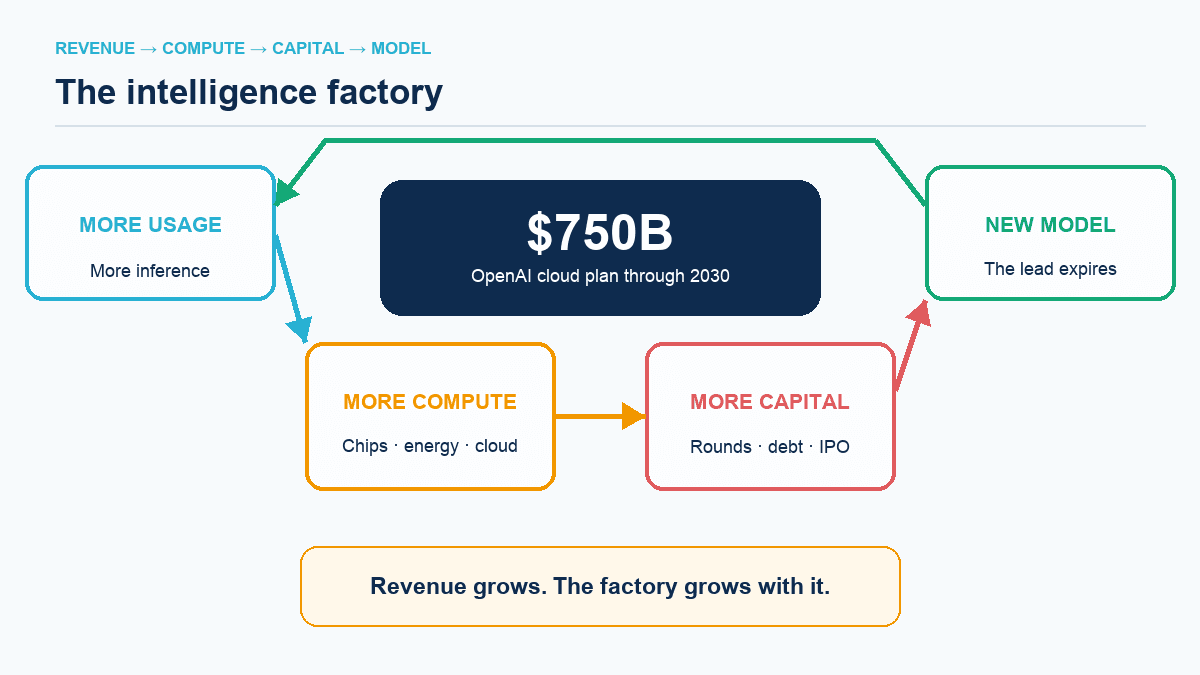
Traditional software could be built once and sold millions of times at low marginal cost. Frontier AI breaks that comfort. More usage requires more inference. A new model consumes another round of chips, energy, data centers, and cloud capacity. The product grows, but the factory must grow with it.
In July 2026, The Wall Street Journal reported that OpenAI had raised its planned cloud spending to $750 billion through 2030 [4]. In September, the company temporarily paused new ChatGPT Pro sign-ups, its $200 plan, because demand for Astra was straining capacity. It was not short of customers. It was short of factory [3].
That combination changes the financial question. Revenue may grow at a historic pace without yet showing the return generated by each additional dollar of compute. A company trapped in this race cannot stop investing: stretch one generation too long and a rival may make it obsolete; train the next too soon and the previous generation gets a shorter amortization period.
When I look at these figures, the word that comes to mind is not scale but exposure. Every product decision commits chips, energy, data centers, and cloud contracts. A company can grow quickly and still not know what return each additional dollar of compute produces.
Private capital can postpone the public verdict
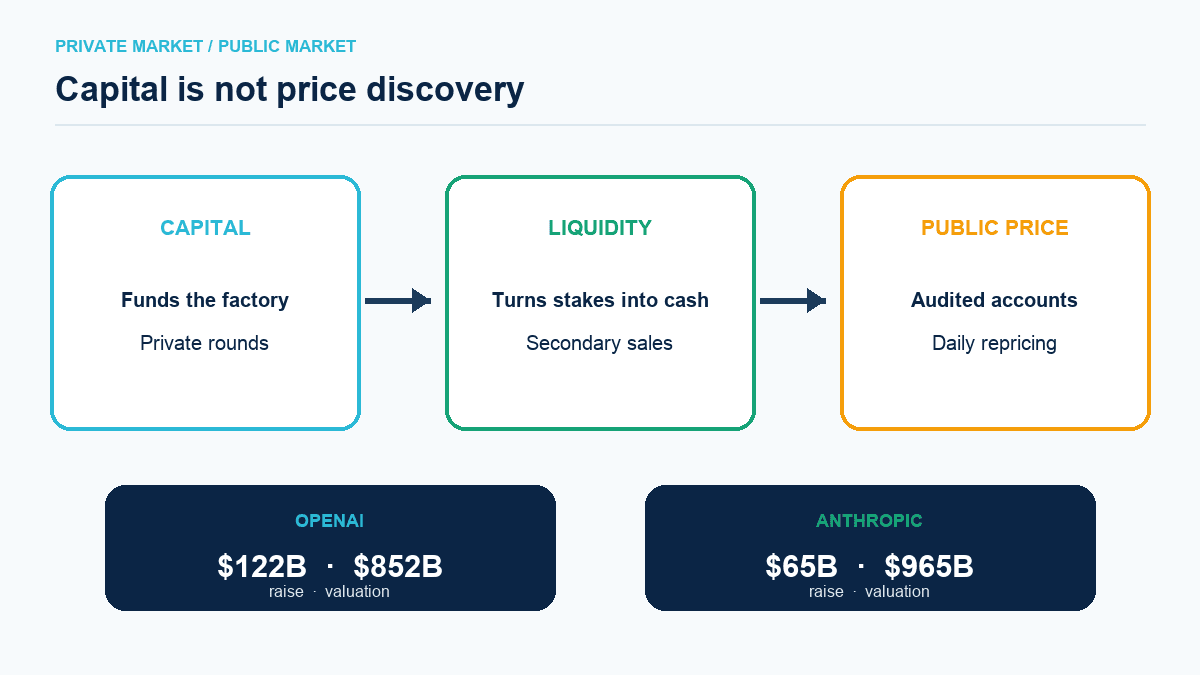
OpenAI announced a $122 billion round in March 2026; Bloomberg placed its post-money valuation at $852 billion [5][18]. Anthropic followed in May with $65 billion at a $965 billion valuation [6][7]. Those sums can finance infrastructure without an immediate public listing.
A private round supplies capital and may create liquidity for selected shareholders. It does not produce the same price discovery as a public market. Listing means publishing audited statements, describing future commitments, answering quarterly, and allowing thousands of investors to reprice the story. That difference matters for a company whose cost of growth remains difficult to measure.
Public investors will ask what it costs to train a generation, what margin remains after inference, which cloud commitments are already signed, and when free cash flow appears. Those are not hostile questions. They separate an extraordinary technology from an extraordinary investment.
The difference matters to me because private capital allows a company to keep telling the future; public markets ask how the present is being paid for. That tension does not invalidate the valuations, but it should change how we talk about growth.
OpenAI's IPO and the three columns we must not mix
Reuters reported in October 2025 that OpenAI was laying the groundwork for an IPO at a potential valuation of up to $1 trillion. In June 2026, the company confidentially filed to list in the United States. On September 12, Sam Altman ruled out a 2026 IPO and publicly tied the decision to an ill-advised moment and the difficulty of prioritizing safety under shareholder pressure [8][9][10][11].
There are three columns. Fact: OpenAI prepared the transaction, filed documents, and moved the timetable. Public explanation: a listed company would have less room to make safety decisions that temporarily hurt results. Inference: remaining private postpones daily scrutiny of costs, margins, and infrastructure commitments.
The inference is economically reasonable, but it does not prove that safety is an excuse. A suggestive timeline is not a confession. OpenAI may be worried about a real risk and simultaneously welcome the fact that the concern justifies delaying the moment when Wall Street inspects its accounts.
There are three columns I prefer not to mix: fact, public explanation, and economic inference. The third is not an accusation, but it should not disappear out of politeness.
What changes when everyone lifts the foot
A lab that slows alone gives an advantage to its rival. If every lab slows under a common rule, the economics of the race change. Training cycles lengthen, the same infrastructure remains productive for longer, and available capital finances more months of operation.
Pacing reduces marginal pressure on CAPEX. Spending does not disappear, but the logic shifts away from buying all available capacity before a competitor does. Each model has more time to recover its training and deployment cost before replacement.
This is where the narrative matters. Slowing because the accounts cannot sustain the race communicates weakness. Slowing because humanity needs safeguards communicates responsibility. The financial move can look similar while the public reading is opposite. That does not make the safety concern false. It explains why a sincere concern can attract exceptionally enthusiastic corporate support.
The moat appears when the challenger becomes dangerous
California designed SB 53 to avoid burdening every startup. The law targets large frontier developers, requires safety frameworks, catastrophic-risk reporting, incident notification, and whistleblower protection. It also provides for CalCompute, a framework for public compute infrastructure [13].
High thresholds defeat the caricature that every programmer will need a license. A barrier, however, does not need to prevent a company from being born. It can wait until that company begins competing at the frontier. Then come evaluators, audits, documentation, lawyers, regulatory relationships, and internal systems that the incumbent already funds as part of its structure.
The GAO documented a related pattern after Sarbanes-Oxley: a law needed to restore trust imposed compliance costs that weighed especially heavily on smaller public companies, eventually requiring more scalable guidance [12]. Safety and competition are not incompatible goals. The deciding factor is whether the cost is proportional or nearly fixed.
In my view, that is the point most often missed: a regulatory cost can be reasonable and still be asymmetric. The practical question is who can absorb it for two years before the first euro of return arrives.
Coordinating safety also coordinates competition
Amodei proposes permanent evaluators and coordination among labs with government backing. His stated reason addresses a real problem: no company wants to reduce speed alone if it believes another will use the pause to overtake it. The mechanism lets every participant accept the same limit without sacrificing relative position [2].
The same mechanism solves an economic problem. It prevents a competitor from breaking the investment schedule, forces capability jumps to be justified, and stabilizes a race that consumes capital at a difficult pace. Coordination may be necessary for safety while simultaneously functioning as industrial discipline.
Antitrust law is therefore not an administrative footnote. If labs agree on pace, tests, or limits, the process needs public oversight, verifiable criteria, and researchers who are not financially dependent on the companies they assess. Otherwise, the frontier can become a club that writes its own admission rules.
Personally, I would worry less about a demanding rule than about a rule written by the same actors best positioned to comply with it.
The state keeps the key to compute
A Western slowdown has little value if another power continues without limits. That argument leads to chip export controls, visibility into large data centers, training registries, and agreements between governments. Each measure can have a defensible purpose. Together they create infrastructure for deciding who may compute at scale.
The European Union already uses compute as an indicator of systemic risk for general-purpose models. The AI Act presumes high-impact capabilities above 10^25 operations, while allowing the threshold to be updated and models to be designated by capability [16]. The metric makes supervision easier; it also turns a technical quantity into a legal frontier.
The established lab gets stability and a higher barrier. The state gets visibility into chips, energy, data centers, and models. The challenger pays for compliance. The user ends up depending on fewer providers. This is not a secret allocation. It is emerging through public decisions, cloud contracts, and rules presented one at a time.
I do not read this as a secret allocation. It is the cumulative result of public decisions, cloud contracts, and rules presented one at a time. That is precisely why it is hard to debate: nobody has to coordinate for the final effect to look coordinated.
Where the evidence stops
There is no public proof that OpenAI and Anthropic jointly designed a slowdown to protect their valuations. Their listing timetables actually diverge: OpenAI moved past 2026 while Anthropic continued exploring a major IPO in September [10]. We also do not know the eventual return on today's infrastructure investments.
We do know that concentration already exists. The UK CMA identified more than ninety partnerships and investments around the largest technology firms. The FTC found financial stakes, cloud-spending commitments, consultation rights, and information sharing across Microsoft–OpenAI, Amazon–Anthropic, and Alphabet–Anthropic [14][15]. Regulation is arriving in a market that already has few critical suppliers.
A responsible conclusion does not assign motives we cannot observe. It measures effects. If a rule reduces technical risk and lowers the leaders' burn rate, both outcomes count. If it requires useful audits but pushes out the next competitor, both outcomes count. Analysis begins when safety and economic interest stop being treated as mutually exclusive explanations.
My thesis does not need to prove that anyone lied. It needs to ask who absorbs the cost of a decision presented as neutral.
Fear above, the bill below, and the key in the middle
Editorial thesis
Advanced systems can cause serious damage without consciousness, hatred, or intent. A poorly specified objective and enough access are sufficient. We need evaluations, incident reporting, model-weight security, and accountability for high-impact deployments.
We also need to inspect the accounts. A slower race allows models to be amortized, spending to be contained, and the public-market verdict to be delayed. When the pause comes with fixed costs, incumbent coordination, and state control of compute, safety begins to determine who may compete.
I would not judge a proposal by the moral purity of Dario Amodei or Sam Altman. I would judge its effect. If it reduces risk while preserving independent capacity, public compute access, and competition, it will have done difficult work. If only four companies can train and only those companies can prove compliance, we will not have tamed the frontier. We will have turned fear into its best moat.
References
- [1]OpenAI and Hugging Face partner to address security incident during model evaluation — OpenAI, 2026
- [2]We Must Pace the Frontier — Dario Amodei, 2026
- [3]OpenAI has paused its $200 ChatGPT sign-ups as unprecedented Astra demand strains its system — Fortune, 2026
- [4]OpenAI’s Planned Cloud Spending Hits $750 Billion as Computing Efforts Ramp Up — The Wall Street Journal, 2026
- [5]OpenAI raises $122 billion to accelerate the next phase of AI — OpenAI, 2026
- [6]Anthropic raises $65B in Series H funding at $965B post-money valuation — Anthropic, 2026
- [7]Anthropic's valuation surges to $965 billion, surpassing OpenAI — Reuters, 2026
- [8]OpenAI lays groundwork for juggernaut IPO at up to $1 trillion valuation — Reuters, 2025
- [9]OpenAI files for US IPO after Anthropic as AI giants head to public markets — Reuters, 2026
- [10]OpenAI’s Altman won’t do IPO this year, calls AI extinction risk unacceptable — Reuters, 2026
- [11]OpenAI delaying IPO amid AI safety concerns, Sam Altman says — Axios, 2026
- [12]Sarbanes-Oxley Act: Consideration of Key Principles Needed in Addressing Implementation for Smaller Public Companies — U.S. Government Accountability Office, 2006
- [13]SB 53 — Artificial intelligence models: large developers — California Legislative Information, 2025
- [14]CMA outlines growing concerns in markets for AI Foundation Models — UK Competition and Markets Authority, 2024
- [15]FTC Issues Staff Report on AI Partnerships & Investments Study — U.S. Federal Trade Commission, 2025
- [16]Regulation (EU) 2024/1689 — Artificial Intelligence Act — European Union / EUR-Lex, 2024
- [17]Statement on AI Risk — Center for AI Safety, 2023
- [18]OpenAI Valued at $852 Billion After Completing $122 Billion Round — Bloomberg, 2026

Daniel Conejo Sobrino
Data Engineer
Related Notes